


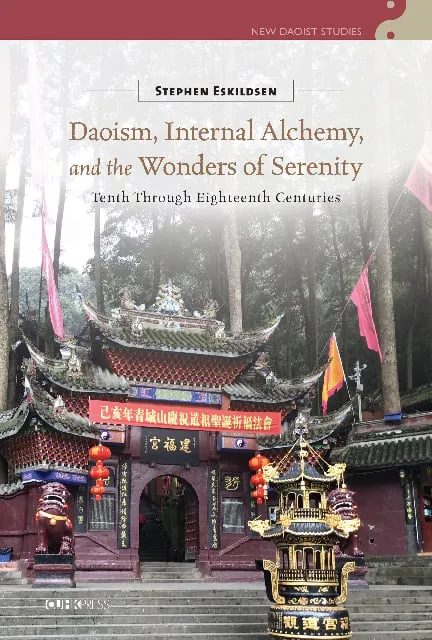
Daoism, Internal Alchemy, and the Wonders of Serenity - Stephen Eskildsen - 文宇宙|Bookniverse
Daoism, Internal Alchemy, and the Wonders of Serenity
Stephen Eskildsen
US $64.00
US $80.00

2026/04
|

9789882373983
|

PDF
|

香港中文大學出版社
 copy
copy书籍简介
查看更多宗教命理 > 其它各教
Simply keeping the mind clear and calm was, for many post-Tang Daoists, the path to eternal life and freedom. Through sheer serenity, practitioners believed they could attain immunity to hunger, eliminate sexual function, suspend breath and pulse, engage in astral travel, and command spirits and natural forces.In his meticulously researched study, Stephen Eskildsen examines how this perspective informed Daoist internal alchemists after the Tang dynasty (618–907), including prominent representatives of the Quanzhen tradition in the north and the Nanzong in the south. Drawing on a wide array of textual sources, he analyzes the teachings of figures like Qiu Chuji (1143–1227), Yin Zhiping (1169–1251), Zhang Boduan (ca. 984–1082), Bai Yuchan (1194– 1229), Li Daochun (fl. 1288–1292), Yu Yan (ca. 1253–1314), and Wu Shouyang (1574–after 1641), among others. These adepts emphasized passive, straightforward methods that they believed gave rise to spontaneous psychic, sensory, and physiological phenomena— approaches they considered more effective than manipulating mind and body with overly complicated techniques.Eskildsen shows how Daoist internal alchemists, by advocating for the maintenance of serenity throughout a mundane life, articulated a unified vision of the Three Teachings— Daoism, Confucianism, and Buddhism— and frequently cited Confucian and Buddhist texts while reinterpreting and adapting their teachings. Particularly notable is their creative reinterpretation of Buddhist concepts such as “non-leakage” and the “Marks of the Great Man,” and their integration of ideas pertaining to the “mind-made body” and the intermediate state. Incorporating such elements played a critical role in shaping their vision of the ultimate soteriological goal: the completion and emancipation of the Yang Spirit. In turn, this Daoist synthesis prompted some to propagate—or ostensibly revive—a Buddhist internal alchemy.Eskildsen offers a compelling contribution to the understanding of Daoism after the Tang, shedding light on a strand of internal alchemy that pursued the sustained cultivation of mental clarity and equanimity above all else.------------------------------------------------------------------------------------------------“Over the last three decades Stephen Eskildsen has created a unique body of scholarship, delving deeply into Daoist ascetic and meditational practices. Characteristic of his work is a profound understanding of the internal logics and motivations that drove practitioners to ever-greater attainments. His current book builds on his earlier study of Daoist meditation from the Latter Han to Tang dynasties to provide a comprehensive picture spanning nearly two millennia. It is an invaluable resource for scholars and practitioners.”——Daniel Burton-Rose, Wenzhou–Kean University“What emerges from this masterful exegetical study is an immersive history of Daoist internal alchemy’s cosmology, doctrines, methodologies, and generations of adepts and masters. Eskildsen’s book fills a major gap in western language publications by broadening significantly our understanding of Daoist inner alchemy in late imperial China.”——Xun Liu, Rutgers University
作者简介
查看更多Stephen Eskildsen
Stephen Eskildsen is professor in the Department of Humanities, International Christian University (Tokyo).
出版社简介
查看更多阅读资讯
请安装 Android 和 iPad/iPhone 「文宇宙」应用程序。这个应用程序会自动与您的账号保持同步,让您随时随地上网或离线阅读。


