


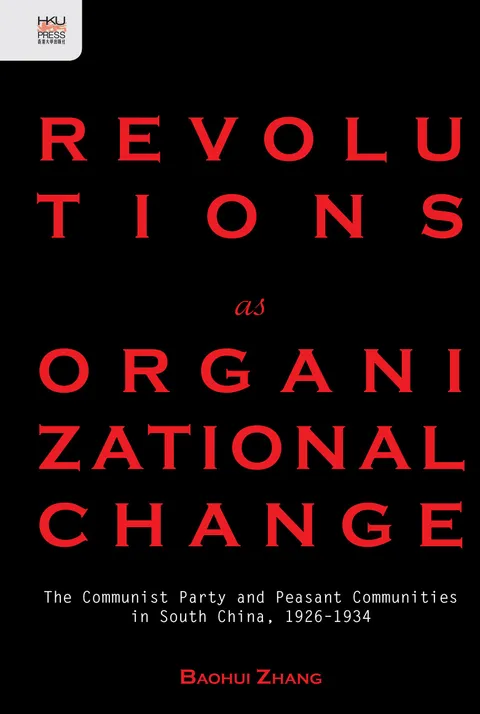
Revolutions as Organizational Change: The Communist Party and Peasant Communities in South China, 1926–1934 - Baohui Zhang - Bookniverse
Revolutions as Organizational Change: The Communist Party and Peasant Communities in South China, 1926–1934
Baohui Zhang
US $32.80
US $41.00

2015/09
|

9789888313730
|

ePub
|

Hong Kong University Press
 copy
About this book
View moreHistory > Chinese History
Humanities & Social Science > Politics > History of Political System
By comparing peasant revolutions in Hunan and Jiangxi between 1926 and 1934, Revolutions as Organizational Change offers a new organizational perspective on peasant revolutions. Utilizing newly available historical materials in the People’s Republic of China in the reform era, it challenges the established view that the great Chinese revolution of the twentieth century was a revolution “made” by the Chinese Communist Party (the CCP).
The book begins with a puzzle presented by the two peasant revolutions. While outside mobilization by the CCP was largely absent in Hunan, peasant revolutionary behaviors were spontaneous and radical. In Jiangxi, however, despite intense mobilization by the CCP, peasants remained passive and conservative. This study seeks to resolve the puzzle by examining the roles of communal cooperative institutions in the making of peasant revolutions. Historically, peasant communities in many parts of the world were regulated by powerful cooperative institutions to confront environmental challenges. This book argues that different communal organizational principles affect peasants’ perceptions of the legitimacy of their communal orders. Agrarian rebellions can be caused by peasants’ attempts to restructure unjust and illegitimate communal organizational orders, while legitimate communal organizational orders can powerfully constrain the mobilization by outside revolutionary agents such as the CCP.
About the author(s)
View moreBaohui Zhang
Baohui Zhang is professor of political science at Lingnan University, Hong Kong. He received his PhD from the University of Texas in Austin. His research interests include political change, Sino-US relations, and international relations of the Asia Pacific.
About the publisher
View moreEstablished in 1956, and part of the University of Hong Kong, Asia’s most prominent English-speaking university, HKU Press publishes more than 30 new titles annually, with a growing proportion (more than 25%) in Chinese. Building on Hong Kong's unique global position, HKU Press books examine, critique, and celebrate Asia’s place in the world. We have gained particular renown for publications in Chinese history and culture, law, public health, social work, film/media studies, art and architecture/urban planning.
Reading information
Install the Bookniverse app for Android and iPad/iPhone . It syncs automatically with your account and allows you to read online or offline wherever you are.


