


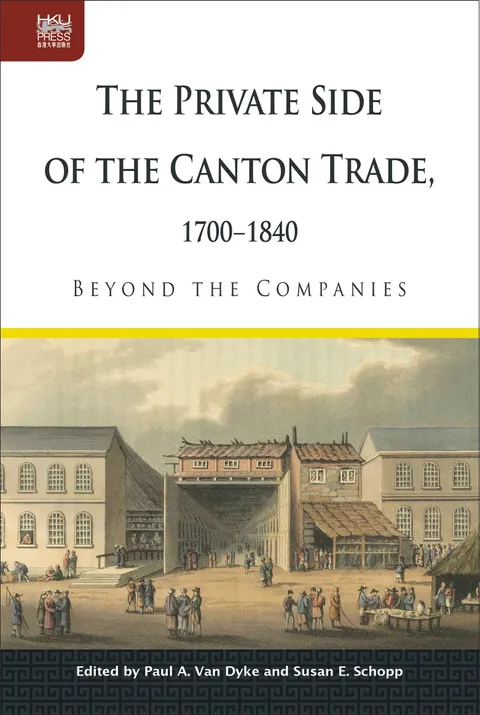
The Private Side of the Canton Trade, 1700–1840: Beyond the Companies - Edited by Paul A. Van Dyke and Susan E. Schopp - Bookniverse
The Private Side of the Canton Trade, 1700–1840: Beyond the Companies
Edited by Paul A. Van Dyke and Susan E. Schopp
US $23.20
US $29.00

2018/03
|

9789888455188
|

ePub
|

Hong Kong University Press
 copy
copyAbout this book
View moreHistory > World History
Humanities & Social Science > Economics > Economic System
It is not often recognized that China was one of the few places in the early modern world where all merchants had equal access to the market. This study shows that private traders, regardless of the volume of their trade, were granted the same privileges in Canton as the large East India companies. All of these companies relied, to some extent, on private capital to finance their operations. Without the investments from individuals, the trade with China would have been greatly hindered. Competitors, large and small, traded alongside each other while enemies traded alongside enemies. Buddhists, Muslims, Catholics, Protestants, Parsees, Armenians, Hindus, and others lived and worked within the small area in the western suburbs of Canton designated for foreigners. Cantonese shopkeepers were not allowed to discriminate against any foreign traders. In fact, the shopkeepers were generally working in a competitive environment, providing customer-oriented service that generated goodwill, friendship, and trust. These contributed to the growth of the trade as a whole. While many private traders were involved in smuggling opium, others, such as Nathan Dunn, were much opposed to it. The case studies in this volume demonstrate that fortunes could be made in China by trading in legitimate items just as successfully as in illegitimate ones, which tellingly suggests that the rapid spread of opium smuggling in China could be a result of inadequate, rather than excessive, regulation by the Qing government.
About the author(s)
View moreEdited by Paul A. Van Dyke and Susan E. Schopp
Paul A. Van Dyke is professor of history at Sun Yat-sen University in Guangzhou and author of Merchants of Canton and Macao: Success and Failure in Eighteenth-Century Chinese Trade (Hong Kong University Press, 2015).
Susan E. Schopp is a historian whose research focuses on the French Canton trade and on East India ships. In 1997 she identified the wreck of the English East India Company vessel Earl Temple. She is also a crew member of Friendship of Salem, a reconstruction of an American East Indiaman.
About the publisher
View moreEstablished in 1956, and part of the University of Hong Kong, Asia’s most prominent English-speaking university, HKU Press publishes more than 30 new titles annually, with a growing proportion (more than 25%) in Chinese. Building on Hong Kong's unique global position, HKU Press books examine, critique, and celebrate Asia’s place in the world. We have gained particular renown for publications in Chinese history and culture, law, public health, social work, film/media studies, art and architecture/urban planning.
Reading information
Install the Bookniverse app for Android and iPad/iPhone . It syncs automatically with your account and allows you to read online or offline wherever you are.
Similar books
日本瞥見記:異文化的觀察與愛戀
US $9.83
US $10.92
Unstoppable Us Vol2: why the world isn't fair
US $23.58
US $26.20
瞄過一眼就忘不了的世界史【商業篇】:SUPER高中老師講故事,讓「金錢流通」當主角,不背年份就能貫通世界史!
US $10.38
US $11.53
Sino-French Trade at Canton, 1698–1842
US $29.60
US $37.00
Narratives of Free Trade: The Commercial Cultures of Early US–China Relations
US $16.00
US $20.00


