


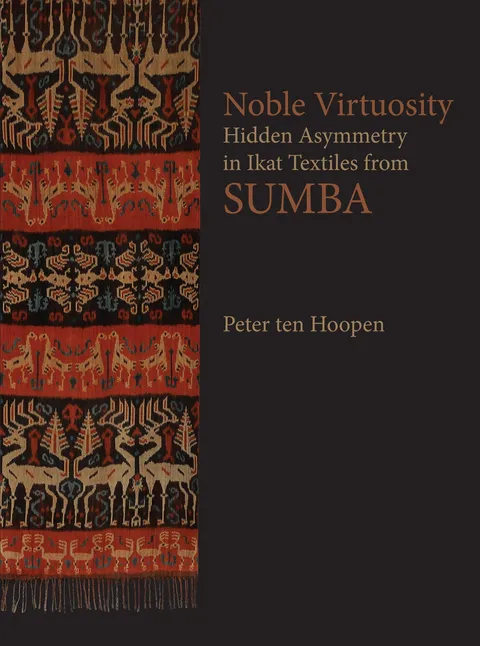
Noble Virtuosity: Hidden Asymmetry in Ikat Textiles from Sumba - Peter ten Hoopen - Bookniverse
Noble Virtuosity: Hidden Asymmetry in Ikat Textiles from Sumba
Peter ten Hoopen
US $51.20
US $64.00

2024/11
|

9789887470854
|

ePub
|

香港大學美術博物館
 copy
copyAbout this book
View more藝術 > 藝術收藏與鑑賞 > 古物鑑賞
In this new study, Peter ten Hoopen reveals levels of virtuosity in the work of Sumbanese textile artists that remained overlooked for over a century of Indonesian textile research. Their richly decorated men’s wraps, hinggi, have commonly been described as symmetric along both axes. But as ten Hoopen’s investigation at Leiden University uncovered, this supposed canon only survived because crucial design elements were overlooked. Sumba’s noble weavers managed to create asymmetry by hiding tiny visual elements that disrupted symmetry and were made to be overlooked. They exploited insights in the way we process visual information by simulating regularity, while deceitfully tying in elements that break it. Ironically, they were so good at hiding these design elements that they remained unnoticed for generations. This virtuosity was a product of Sumba’s competitive culture, suffused by an ancient headhunting ethos and marked by secrecy. As the artists strove to outsmart each other, naturally they guarded their repertoire of tricks. The secrecy also increased the social distance between nobility, commoners and slaves, reinforcing Sumba’s feudal societal structure. Only high-caste initiates would even begin to look for hidden devices. Ten Hoopen himself also overlooked them for decades until his eyes were opened and he began hunting for them actively. His findings reveal not just the Sumbanese dyers’ virtuosity, but also their playfulness and the element of ‘flow’ that inspired their work. This ode to the Sumbanese weavers’ ingenuity aims to create a new global class of initiates and to inspire even greater admiration for their art.
About the author(s)
View morePeter ten Hoopen
Peter ten Hoopen began collecting and studying Indonesian ikat in the late 1970s. He has curated two exhibitions of his textiles in Europe and one in Hong Kong, and published five books on the subject, including Ikat Textiles of the Indonesian Archipelago, the first reference work on the subject. His previous publication Noble Virtuosity reveals levels of virtuosity in the work of Sumbanese textile artists that remained overlooked for over a century of Indonesian textile research.
About the publisher
View more自1953年成立以來,香港大學美術博物館(UMAG)逐步建立起豐富多元的館藏,涵蓋陶瓷、青銅器、家具以及紙本藝術品,藏品年代橫跨新石器時代(約公元前7000年至約公元前2100年)至清朝(1644–1911年),同時收藏自明朝(1368–1644年)至二十一世紀的傳統與現代繪畫。UMAG的出版計劃亦積極配合博物館活動,不僅有展覽圖錄,亦出版涵蓋廣泛藝術史主題、以東亞為重點的原創學術著作。
Reading information
Install the Bookniverse app for Android and iPad/iPhone . It syncs automatically with your account and allows you to read online or offline wherever you are.


